
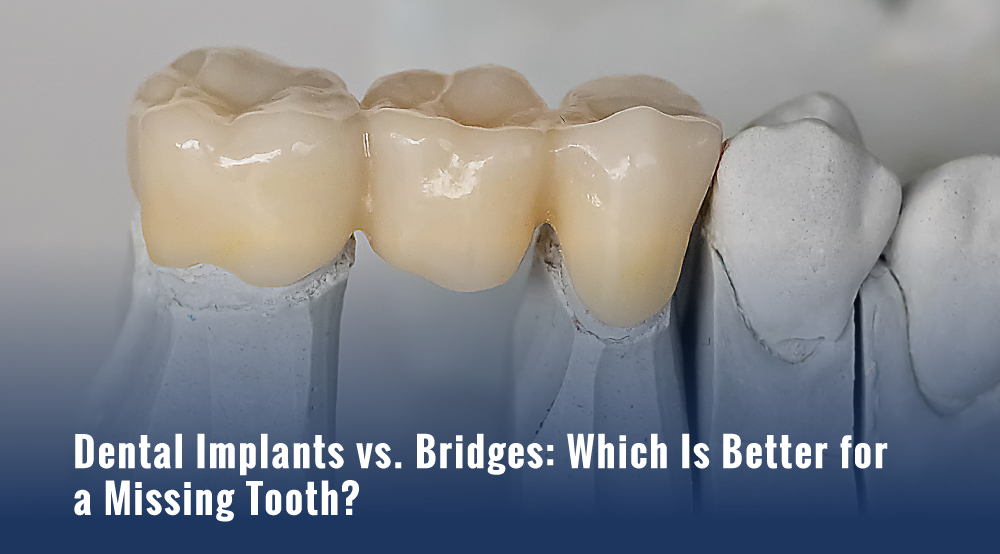
Dental implants and bridges can both replace a missing tooth, but they work very differently. An implant replaces the missing tooth without relying on adjacent teeth for support, while a traditional bridge uses neighboring teeth to hold a replacement tooth in position. Neither solution is automatically better for everyone.
Patients comparing dental implants in Thousand Oaks should consider jawbone health, gum health, treatment time, surgery, and the condition of nearby teeth. An implant can provide an independent replacement that also places functional forces into the jawbone, but treatment typically requires surgery and a healing period.
Dental bridges in Thousand Oaks can offer a nonsurgical solution that is often completed more quickly. A traditional bridge may be particularly practical when neighboring teeth already need crowns, although healthy supporting teeth generally need to be reshaped to hold the restoration.
How Dental Implants and Bridges Replace a Missing Tooth
A dental implant replaces the root portion of a missing tooth with an implant placed in the jawbone. After appropriate healing, an abutment and crown are attached to create the visible replacement tooth.
A traditional bridge works differently. Crowns are placed on teeth on either side of the open space, and a replacement tooth called a pontic is connected between them.
An implant-supported bridge may be considered when several teeth are missing. Instead of relying entirely on natural teeth for support, strategically positioned implants support multiple replacement teeth.
Both approaches can restore the visible space and improve chewing, but their underlying structures are fundamentally different.
Effects on Neighboring Teeth
One significant advantage of a single dental implant is that adjacent healthy teeth generally do not need to be reshaped simply to support the replacement.
That can make dental implants in Thousand Oaks appealing when the teeth next to the gap are healthy and largely untouched.
A traditional bridge requires supporting teeth on each side of the missing tooth to be prepared for crowns. That may be a reasonable tradeoff when those teeth already have large fillings, fractures, or other conditions that make crowns beneficial.
For someone with completely healthy neighboring teeth, preserving their existing structure may weigh more heavily in the decision.
Bone Health and Long-Term Jaw Support
Natural tooth roots transfer forces into the jawbone during chewing. After a tooth is removed, that stimulation disappears and the bone in the area can gradually change.
An implant functions within the jawbone and can help maintain functional stimulation in the area where the natural root was lost.
A traditional bridge fills the visible gap but does not place a replacement root into the bone. Bone loss after tooth loss can therefore continue beneath the pontic.
This does not mean every person who has experienced bone changes is unable to receive an implant. Bone volume can be evaluated with appropriate imaging, and grafting may be an option in some situations.
Lifespan and Maintenance Comparison
Both treatments require good oral hygiene and regular dental care.
An implant crown needs brushing and flossing around the restoration and gumline. Although the implant itself cannot develop a cavity, inflammation and bone loss around an implant can threaten its long-term stability.
Dental bridges in Thousand Oaks require additional cleaning underneath the replacement tooth and around the supporting crowns. Floss threaders, interdental brushes, or other cleaning aids may be recommended to remove plaque from areas a regular toothbrush cannot reach.
No restoration should be considered permanent or maintenance-free. Longevity depends on oral hygiene, bite forces, grinding habits, gum and bone health, restoration quality, and other individual factors.
Cost and Insurance Considerations
The initial cost of an implant can be higher than that of a traditional bridge, particularly when additional procedures such as bone grafting are necessary.
Dental implant cost can involve several components, such as imaging, surgical placement, the implant itself, an abutment, and the final crown. Patients should ask whether an estimate represents the entire treatment or only one phase.
Insurance coverage also varies. A plan may contribute toward a bridge, implant restoration, or certain associated procedures while excluding others or applying annual maximums.
Cost comparisons are more useful when they consider the complete treatment, anticipated maintenance, and condition of neighboring teeth rather than comparing only the first quoted price.
Which Patients Are Better Suited for Each Option?
A healthy adult with sufficient bone, suitable gum health, and healthy neighboring teeth may be a good candidate for an implant. Patients should also be able to undergo the surgical procedure and allow time for healing.
Someone who wants to avoid surgery or who has adjacent teeth that already require crowns may find a bridge worth considering.
Restorative dentistry in Thousand Oaks should take the entire mouth into account rather than treating the empty space in isolation. The dentist may consider:
- Number and location of missing teeth
- Condition of neighboring teeth
- Jawbone volume
- Gum health
- Medical history
- Bite forces
- Teeth grinding
- Treatment timeline
- Budget and insurance benefits
- Long-term maintenance preferences
The best treatment is the one suited to the patient’s individual dental condition and priorities.
Replacing a Missing Tooth in Thousand Oaks after Bone Loss
Waiting to pursue missing tooth replacement can allow changes to occur in the area of the lost tooth. Nearby teeth may shift, the opposing tooth may move toward the open space, and the jawbone in the area can gradually lose volume.
Patients considering dental implants in Thousand Oaks can have the bone evaluated to determine whether enough support remains for implant placement. When bone volume is inadequate, grafting may sometimes help rebuild the area before or during implant treatment.
A bridge does not require an implant to be placed into the jawbone, so it may remain an option when implant surgery is not appropriate or desired.
The decision should account for more than filling the visible gap. How the replacement affects surrounding teeth, bone, bite, hygiene, and future dental care can matter for years after treatment is completed.
Summary
Dental implants replace a missing tooth independently and provide support within the jawbone, while traditional bridges rely on neighboring teeth to support the replacement. Each approach has advantages, limitations, different treatment timelines, and different maintenance requirements.
For patients considering restorative treatment, the condition of neighboring teeth, available bone, oral health, surgical considerations, cost, and personal priorities can help determine the appropriate solution. A thorough evaluation can compare the options based on the individual mouth rather than assuming that one treatment is best for every missing tooth.
Frequently Asked Questions
Is an implant always better than a bridge?
No. Implants can preserve neighboring tooth structure and provide support within the jawbone, but surgery, healing time, bone availability, health considerations, and cost can affect candidacy. A bridge may be appropriate in other circumstances.
How long does it take to replace a tooth with an implant?
Treatment can take several months when healing is required before the final crown is placed. Bone grafting or other preparatory procedures can extend the timeline.
Does a bridge damage the teeth next to the missing tooth?
Traditional bridges require supporting teeth to be reshaped for crowns. Whether this is a disadvantage depends partly on the existing condition of those teeth.
Can I get an implant if my tooth has been missing for years?
Possibly. The dentist needs to evaluate the amount of available bone and other oral health factors. Bone grafting may be considered when additional support is necessary.
Which option is easier to clean?
Both require consistent oral hygiene. A single implant can be cleaned around much like an individual tooth, while a bridge requires cleaning beneath the replacement tooth as well as around its supporting crowns.
Find Dental Implants Near Me: Newbury Dental Group in Thousand Oaks
Searching for dental implants near me? If you live in the Thousand Oaks area, you need look no further than Newbury Dental Group. Newbury Dental Group is a top dental clinic where you’ll receive the best of care. We specialize in dental implants and other forms of cosmetic dentistry solutions so call today – (805) 375-9383.