
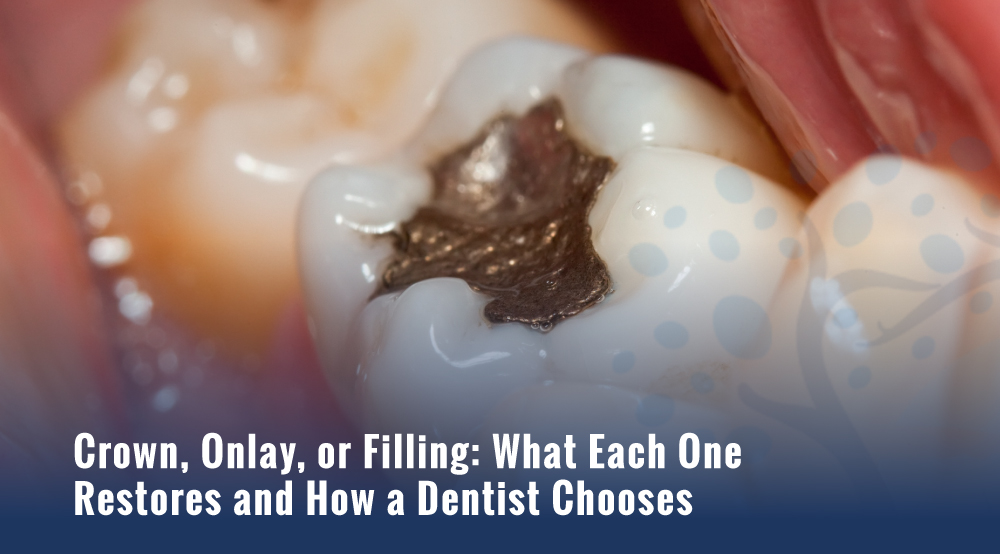
When decay, an old restoration, or a fracture weakens a tooth, dental crowns in Thousand Oaks are only one possible solution. A filling or onlay may preserve more natural structure when the remaining tooth is strong enough to support a smaller restoration.
A dental crowns vs fillings comparison begins with the amount and location of the damage. The dentist also considers the strength of the remaining walls, the position of the tooth, bite pressure, nerve health, and whether previous dental work has failed.
The Amount of Remaining Tooth Structure Decides the Restoration
The size of the cavity does not tell the complete story. Two teeth with similarly sized areas of decay may require different restorations because one has stronger surrounding walls.
A filling fits within the damaged area, while an onlay covers one or more weakened cusps. A crown surrounds the entire visible portion of the tooth and distributes pressure across the remaining structure.
The dentist evaluates:
- The Amount of Healthy Enamel Remaining
- The Thickness of the Tooth Walls
- Whether a Cusp Is Cracked or Undermined
- The Size of an Existing Filling
- The Location of the Tooth
- Normal Bite Pressure
- Clenching or Grinding Habits
- The Health of the Tooth’s Nerve
The objective is to remove decay or damaged material while preserving healthy tooth structure whenever doing so will provide a dependable result.
Fillings Work When Healthy Walls Still Surround the Cavity
A filling replaces a relatively small or moderate area damaged by decay, wear, or fracture. Tooth-colored composite material is placed directly into the prepared area, shaped, and hardened during the appointment.
Fillings depend on the surrounding tooth for support. They may work well when the remaining walls and cusps are thick enough to handle normal chewing pressure.
When a filling becomes too large, the tooth walls around it can become thin and more likely to fracture. Replacing an old filling with an even larger one may not provide enough reinforcement.
A dental crowns vs fillings decision therefore considers structure rather than cost alone. A filling may require less preparation, but selecting it for a severely weakened tooth could result in another break and more extensive treatment later.
Onlays Rebuild a Cusp Without Covering the Entire Tooth
An onlay is a custom restoration that fits over a damaged section and covers at least one cusp. It provides more coverage than a filling without surrounding the entire tooth like a crown.
A dental onlay in Thousand Oaks may be considered when decay, a crack, or an old filling has weakened part of a molar or premolar. If other walls and cusps remain healthy, an onlay can preserve those areas.
Onlays may be created from porcelain, ceramic, composite resin, or metal. The dentist prepares the damaged area, takes a digital scan or impression, and places a temporary restoration when the final onlay cannot be completed during the same visit.
Once bonded into position, the onlay helps restore the tooth’s chewing surface and reinforce the covered cusps. It cannot stabilize every fracture, particularly one that extends deeply through several walls or toward the root.
Crowns Cover Everything and Are Chosen When the Walls Are Compromised
A crown covers the visible portion of a tooth above the gum line. It may be recommended when extensive decay, a large filling, or a fracture leaves the remaining walls unable to carry normal chewing forces.
Dental crowns in Thousand Oaks can restore damaged front teeth, premolars, and molars. The design and material are selected according to the tooth’s location and functional requirements.
A crown may be considered when:
- Several Tooth Walls Are Thin or Missing
- One or More Cusps Have Fractured
- A Crack Weakens the Tooth
- An Existing Filling Occupies Most of the Tooth
- Significant Wear Has Reduced Tooth Height
- Root Canal Therapy Has Altered the Tooth’s Structure
A crown cannot repair a fracture that makes the root unrestorable. Diagnostic testing is necessary to confirm that the tooth has enough healthy structure and support.
Root Canal Treated Teeth Usually Require Full Coverage
Root canal therapy removes inflamed or infected tissue from inside a tooth. The internal spaces are cleaned, shaped, and sealed, but the procedure does not rebuild the exterior structure lost to decay, fracture, or previous restorations.
A crown after root canal treatment is frequently recommended for a molar or premolar because these teeth absorb considerable chewing pressure. Full coverage helps protect weakened cusps from separating.
Front teeth may not always require crowns following root canal therapy. A front tooth with limited structural loss may sometimes be restored with bonding or a filling. The choice depends on how much natural structure remains and whether the tooth must support another restoration.
The dentist also evaluates cracks before beginning treatment. Root canal therapy can treat damaged pulp, but it cannot prevent a deep root fracture from spreading.
Material Choice Depends on Position, Bite Force, and Visibility
The types of dental crowns include porcelain, ceramic, zirconia, porcelain fused to metal, and full metal restorations. Each provides a different balance of appearance, strength, thickness, and wear against opposing teeth.
Porcelain and ceramic materials can closely resemble natural enamel, making them useful in visible areas. Zirconia offers substantial strength while maintaining a tooth-colored appearance. Metal crowns are highly durable but remain visibly metallic.
Material selection may depend on:
- Whether the Tooth Shows When Smiling
- The Amount of Space Available
- The Patient’s Bite Force
- Clenching or Grinding
- The Condition of the Opposing Teeth
- The Amount of Healthy Structure Remaining
- The Need to Match Nearby Restorations
Patients comparing dental crowns in Westlake Village or Thousand Oaks should ask why a particular material is recommended for the treated tooth rather than assuming one material is best for every location.
The Goal Is the Restoration That Will Actually Hold
The smallest restoration is not always the most conservative choice over the long term. A filling that fails and allows the tooth to fracture may ultimately remove more structure than an onlay or crown selected earlier.
The dentist must balance preservation with durability. A filling should be large enough to remove damaged tissue but small enough to remain supported. An onlay should cover weakened cusps without unnecessarily surrounding healthy walls. A crown should provide full coverage when the remaining tooth cannot function predictably with less protection.
Routine examinations can identify failing fillings, fractures, and decay before substantial damage occurs. Treating a problem earlier may make a smaller restoration possible.
At Newbury Dental Group, patients considering dental crowns in Thousand Oaks can receive an examination to determine whether a filling, onlay, or crown provides the appropriate level of coverage.
Frequently Asked Questions
Is an onlay better than a crown?
An onlay may be more conservative when only one or more cusps require coverage and the other tooth walls remain healthy. A crown may be more appropriate when damage affects most of the visible tooth. Neither restoration is automatically better for every situation.
How long do fillings, onlays, and crowns last?
Longevity depends on the material, restoration size, tooth location, oral hygiene, bite force, and grinding habits. Regular dental examinations can identify wear, leakage, cracks, or decay before the restoration fails completely.
Does every tooth need a crown after root canal therapy?
No. Molars and premolars frequently require full coverage because they absorb substantial chewing pressure. Some front teeth may be restored with bonding or a filling when enough healthy structure remains. The dentist determines the appropriate restoration after evaluating the tooth.
Can Newbury Dental Group replace an old or damaged crown?
Yes. Newbury Dental Group can examine the crown, supporting tooth, gums, and bite to determine why the restoration failed. Treatment may involve replacing the crown, treating decay, repairing the foundation, or addressing damage to the tooth.
How does a dentist choose between a filling and a crown?
The decision is based on the amount of healthy tooth remaining, the condition of the walls and cusps, the location of the damage, and expected bite pressure. Dental crowns vs fillings cannot be compared by cavity size alone because the strength of the surrounding structure also matters.
Summary
A filling restores a limited area when healthy tooth walls still provide support, while an onlay covers weakened cusps without surrounding the entire tooth. A crown provides full coverage when decay, fractures, wear, or previous restorations leave the tooth unable to carry normal pressure. A dental crowns vs fillings evaluation considers remaining structure, nerve health, bite force, tooth position, and long-term durability so the selected restoration provides enough protection without removing healthy tissue unnecessarily.
Dental Crowns in Thousand Oaks: Newbury Dental Group
Don’t let a tooth issue get you down. Get help now. If you live in the Thousand Oaks area, you need look no further than Newbury Dental Group for a dental crown. Newbury Dental Group is a top dental clinic where you’ll receive the best of care. Call today – (805) 375-9383.